
The Hopeful Beginnings
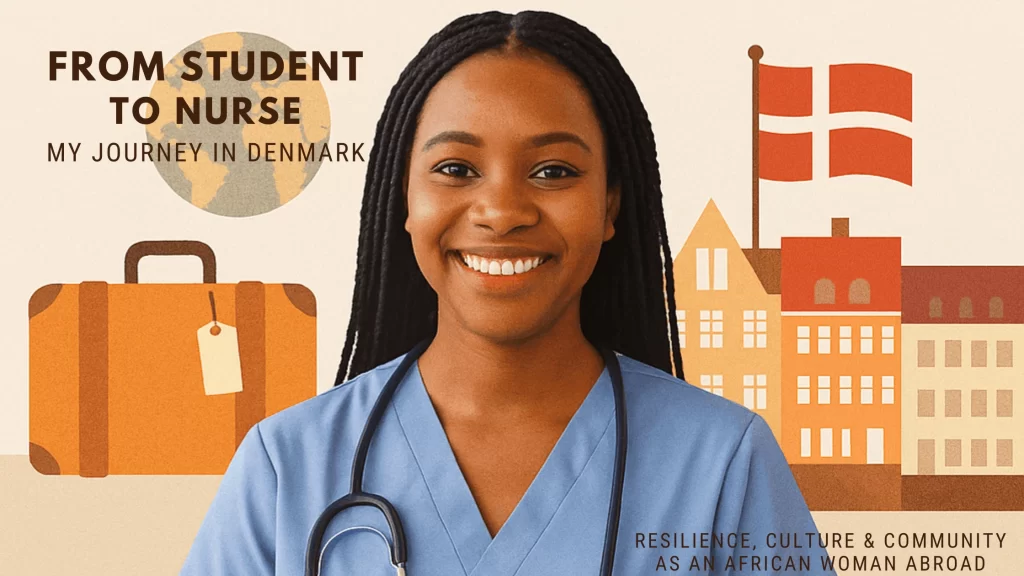
I moved to Denmark two decades ago with high expectations and hope. Starry-eyed and in awe of all I had seen. Taking in the undeniable change of atmosphere, smell, and impression without imagining life waiting for me on the other side. My arrival as an international student was full of hopes, fears, and questions. After years of studying, working, and building a home here, I am grateful and, at the same time, deeply aware of the many layers of being an African foreigner in a Scandinavian country.
In this post, I want to share my journey: from student life to becoming a nurse, from cultural shocks to finding community, and from raising children in Denmark to navigating what it means to belong in a place so different from my birth country.
Adjusting to a New Life
I arrived in Denmark with a student visa and big dreams. The first few months were cold, and I mean that in every sense: weather, social life, and even food! I remember one particularly chilly Sunday when I was evicted from my shared apartment over a misunderstanding where I lived with my roommates and suddenly decided to send us packing. Our offence was opening a letter that didn’t belong to us.
I acknowledged the wrongdoing and pleaded, but they wouldn’t accept my apologies. They decided the snowy Sunday morning was the perfect day to send us packing. We packed our belongings- everyone in the apartment- without knowing where to go, shivering in the roughly four inches of snow. I called one of our acquaintances at our church, and she allowed me to stay in the one room she shared with her husband. Her husband had travelled, so it was a blessing. Even if he had been home, she wouldn’t have refused.
I am forever grateful for the help this woman provided me. She housed me, offered warmth, food, and shelter, and encouraged me to attend classes, though it was the last thing on my mind. I was stressed. This highlights the importance of having a community of people to fall back on. No one can predict what will happen from one day to the next.
When Homesickness kicks In
Because of this experience, I convinced myself that Scandinavia was not the right place for me. I didn’t like the dreary, gloomy, and depressing atmosphere during the winter months. The food was completely different from what I was used to, and everything tasted strange. The imported African food was expensive, and as a student, I couldn’t afford everything I would have loved to eat. However, as time passed, I became accustomed to eating the available food. As I earned more money, I could purchase some of my favourites, though still not as much as I would have liked.
Facing Cultural Differences and Prejudice
The silence on public transport was deafening compared to the vibrant streets back home. It became even worse when some Danish people deliberately or accidentally chose not to sit beside me, regardless of how complete the train was, leaving the only available seat next to me. They preferred to stand. Nonetheless, the education system impressed me; it is structured, focuses on independent and collective learning, and technology supports it in ways I hadn’t experienced before.
Although I received support from my teachers and the entire administrative team at the school during my time as an African student in Denmark, it is essential to acknowledge the issue of prejudice in the classroom. Initially, you may face bias from individuals who are not Danish, as there are very few African students in Danish schools.
At one point, some Eastern European individuals who were themselves migrant students before joining the EU displayed specific behaviour when they saw African people. They exhibited more prejudice than the natives. There was an incident where one person asked me why I had come to cold Denmark from a warmer climate, stating that they did not understand why people like us were allowed into Denmark.
They grouped with the Asians and refused to associate with people like me. Eventually, I formed a group with a white Brazilian and two Americans. After our first project, which was the best in the class, they softened, and some wanted to join our group. You might face this kind of bias; do not let this deter you; let your success answer for you.
Despite all that happened at that time, I kept on pushing. And now, I have lived in Denmark for more than twenty years and counting.
However, the journey was far from solitary. The unwavering support of friends and acquaintances was a beacon of hope during the daunting early days. Like many other international students, I had to adapt to a new learning style and find ways to make ends meet through part-time jobs.
Changing Career from Multimedia Design to Nursing
After a while, I realised that securing a job in Denmark involved more than simply earning a degree. The degree must be relevant to society, especially if you plan to retain your residency and later change your status to a permanent one. To avoid competing with the indigenous Danish people with my degree in multimedia design, which might result in unemployment. I decided to pursue nursing instead since I was already working at a care home, and there was and is still a significant nursing shortage globally.
This decision was the best I had ever made, and it became my path to becoming a naturalised Danish citizen.
Nursing School Requirements in Denmark
Becoming a nurse in Denmark was not simple; it involved intensive language learning and constant practice, which I got from my part-time job at the nursing home and at home. Theoretical and practical training and a deep understanding of the Danish healthcare system. However, I leveraged my passion for working with people, my desire to earn a decent living, integrate appropriately into society, and, most of all, secure a work permit that would transition me from student visa status to work visa status to achieve the desired outcome. Adjusting to the different work cultures in the healthcare system was another challenge. Still, once I was in, I found a purpose. I learned to love the Danish work culture, which is respectful, balanced, and intensely focused on quality of care.
This is the kind of resilience that living outside your home and comfort zone brings into your life. You will be tested with challenges, but thinking outside the box, mentally searching for possibilities, and preparing thoroughly to make those possibilities a reality may involve stress-inducing situations, but the result is usually unquantifiable. There is no problem without solutions.
Being a Black African nurse in Denmark
This came with its own set of experiences. Some patients were curious, some sceptical, and a few downright rude. I faced challenges such as patients questioning my qualifications, making assumptions about my background, and even instances of overt racism.
For example, sometimes patients would request a “real” Danish nurse or assume I was a nurse assistant rather than a nurse. Some would ignorantly ask where I studied to make sure someone with a degree from Africa is not caring for them. Most of all, I met people who valued my work, knowledge, and presence.
It is still a work in progress. I continue learning and growing, moving gracefully and professionally through these challenges. Though these experiences might be difficult, they have been instrumental in shaping how I understand diversity in culture and inclusion, especially in the healthcare system.
Life as a Foreigner: The Sweet and the Bitter
Living in Denmark offers many advantages, including safety, strong social systems, healthcare, and a calm pace. However, it also comes with isolation, especially at the beginning, and making friends can be hard.
The unspoken cultural rules, the emphasis on privacy, and the subtle feeling of always being “different” can wear you down. However, these moments when we feel isolated can be the catalyst to genuinely appreciating beauty in diversity. Embracing cultural differences, learning from each other, and finding common ground can enrich relationships.
As a woman of African origin, my journey in Denmark has been marked by inclusion and microaggressions. I’ve had to teach my children about the silent face of racism. Amid all these challenges, the African community, my immediate family, religious groups, colleagues and acquaintances have given me the needed strength.
These communities have provided comfort, empowerment, and a reminder of my roots. They have provided a space to be myself, share my experiences, and learn from others in the same situation. Their support has been invaluable in helping with the complexity of living in a foreign country. They have shown me the immense value of building a support network and finding people who are already living the journey and can offer guidance and solace when needed.
Raising Children in the Western World
Raising Children in the Western World has been one of my biggest learning curves. Danish parenting is very child-focused, encouraging children to speak their minds, question authority, and explore freely. This is a beautiful aspect of their culture, but it’s also very different from how many of us were raised.
Language, identity and the Mistake I regret
Preserving my values and embracing the norms in this new place I have called home has been challenging. While teaching my children to respect elders and understand their origins is non-negotiable for me, speaking my primary language, Yoruba, has not been prioritised since I had to learn Danish in depth and use it at home and work to improve. In other words, I usurped my children’s chances of learning our mother tongue for my personal goal.
We spoke only two languages at home: Danish and English. We used English because everyone back home, including my mother, can at least speak the pidgin language, a version of English widely spoken in my home country, Nigeria. Doing so would help them communicate with everyone. There is a form of inferiority complex attached to children not speaking English. Consequently, many people in our situation tend to abandon their own mother tongue for another language, viewing it as more elitist and widely accepted.
This was a grave mistake in the long run, and our decision was not well thought out because the children would have eventually learned English at school. We regret this decision today. Do not make the same Mistake. Our children are now on track to learn our mother tongue.
But aside from all of the language issues, I also love that they’re learning independence, confidence, and open-mindedness. Though we have always had to interchange the two cultures and values, we have been able to hold on to our roots while making new experiences, making our journey remarkable and inspiring.
Of course, there are challenges: identity confusion, feeling like they’re “not Danish enough” or “not African enough,” and navigating the social expectations of both worlds. But we face them together, and I’m intentional about keeping our roots alive at home.
What I’ve Learned and What I Want You to Know
If you’re thinking of coming to Denmark to study, work, or build a life, here’s what I want you to know:
- Learn to connect with your professors. They want to help you.
- Utilise the syllabus provided to you.
- Prepare for class by studying in advance.
- Always be punctual and attend your study groups.
- You must cultivate strong relationships in study and group work.
- Be open, yet stay grounded. Adapt, but don’t lose your essence.
- Learning the language opens doors not only for jobs but also for authentic connections.
- Build your community early. Don’t wait.
- Remember: It’s okay to feel out of place. That feeling fades with time and effort.
- Your background is not a disadvantage; it’s your strength.
This journey has shaped me in ways I couldn’t have imagined. If you’re on the same path, I hope my story reminds you that you are not alone.
✨ Conclusion
My journey from a hopeful student to a nurse, mother, and citizen of Denmark has been anything but easy. It has been worth it, though. Every struggle shaped me, and every success strengthened me.
To anyone navigating life in a foreign land, whether you’re just arriving or have been here for years, know that your experience matters. Your background is not a barrier; it is a bridge. It connects you to others, enriches the society you now live in, and brings unique value to everything you touch. Stay grounded in your values, and trust that you are shaping a meaningful story as I continue to shape mine.
✨ Thank you for reading my story.
If you’re an international student, healthcare professional, or simply navigating life in a new culture, I’d love to hear your journey.
💬 Drop a comment below to share your experiences or ask questions.
📩 Subscribe to my blog for more stories on migration, motherhood, career, and culture.
💡 Know someone who might benefit from this story?
👉 Share this post and let them know they’re not alone.